Sozinhos juntos | Alone Together
Série | Series III
O isolamento não depende de quantas pessoas estejam em volta
Isolation doesn’t depend on how many people are around youDezesseis obras · fotografia · quatro países · mais de cinquenta anos
Estar perto não é estar junto.
A AUTORA
Cinquenta anos olhando quem passa
Meio século de fotografia e, antes disso, formação em design seguida de duas décadas de direção de arte. Dessa origem vem o traço mais visível deste conjunto: um olho educado para a proporção, que decide onde cai cada figura dentro do retângulo e como as massas se equilibram — e que, em várias destas obras, resolveu a composição antes que a autora soubesse qual era o assunto.
O arquivo cobre mais de cinquenta anos e quatro países. As ferramentas variam sem que o olhar mude: há aqui negativos em preto e branco revelados décadas atrás, imagens feitas com telefone celular, uma câmera compacta e uma fotografia tomada de dentro de um carro em movimento. O que se repete não é o equipamento nem o lugar — é a posição de quem observa sem participar.
Esta autora tem um método declarado e um limite declarado. O método é ver a fotografia antes de fazê-la: ela afirma que em muitas ocasiões sabe de antemão como a imagem vai ficar. O limite aparece quando isso não acontece — e é justamente nessas obras que o conjunto se formou.
A SÉRIE
Dezesseis vezes a mesma distância
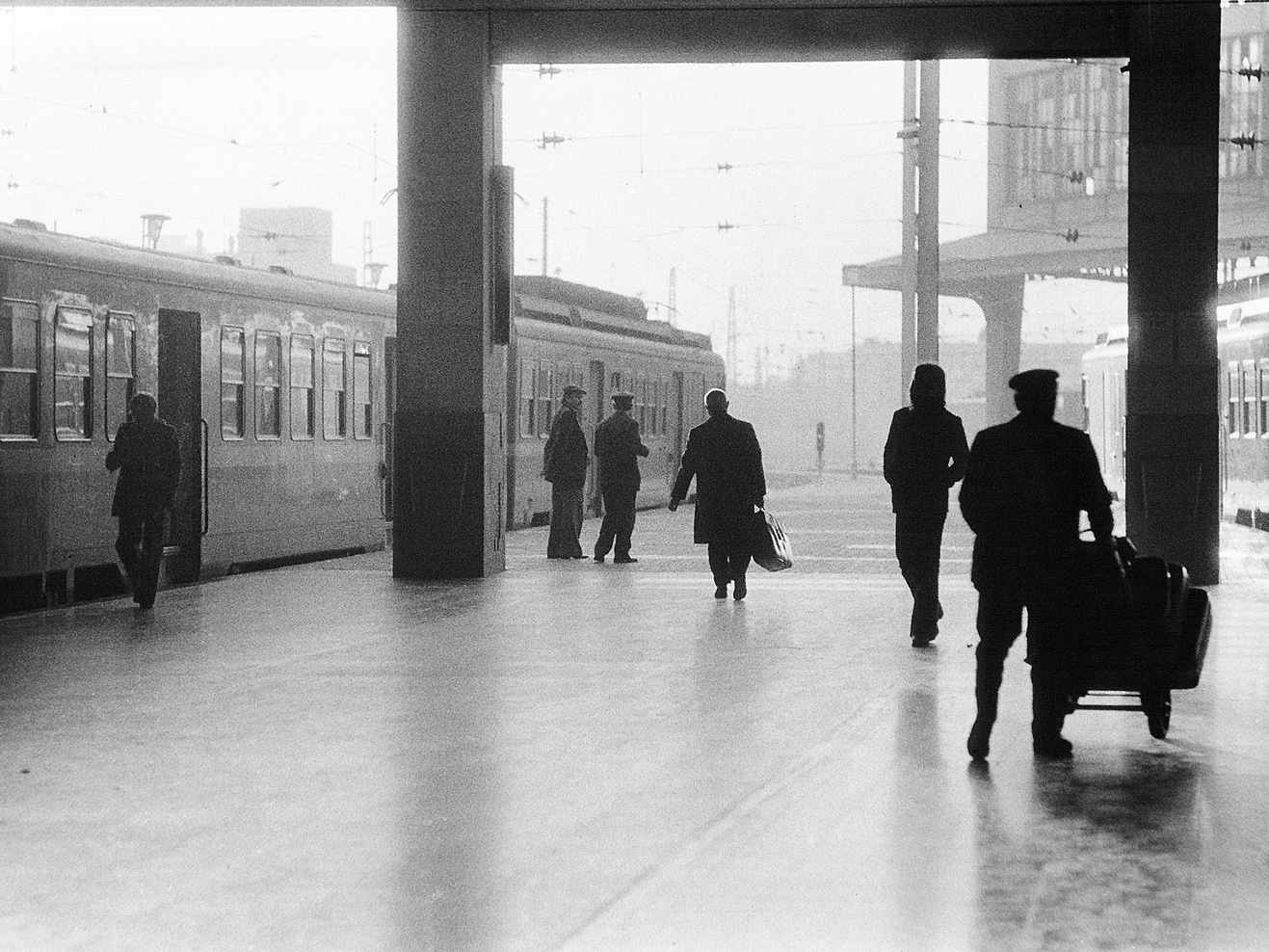
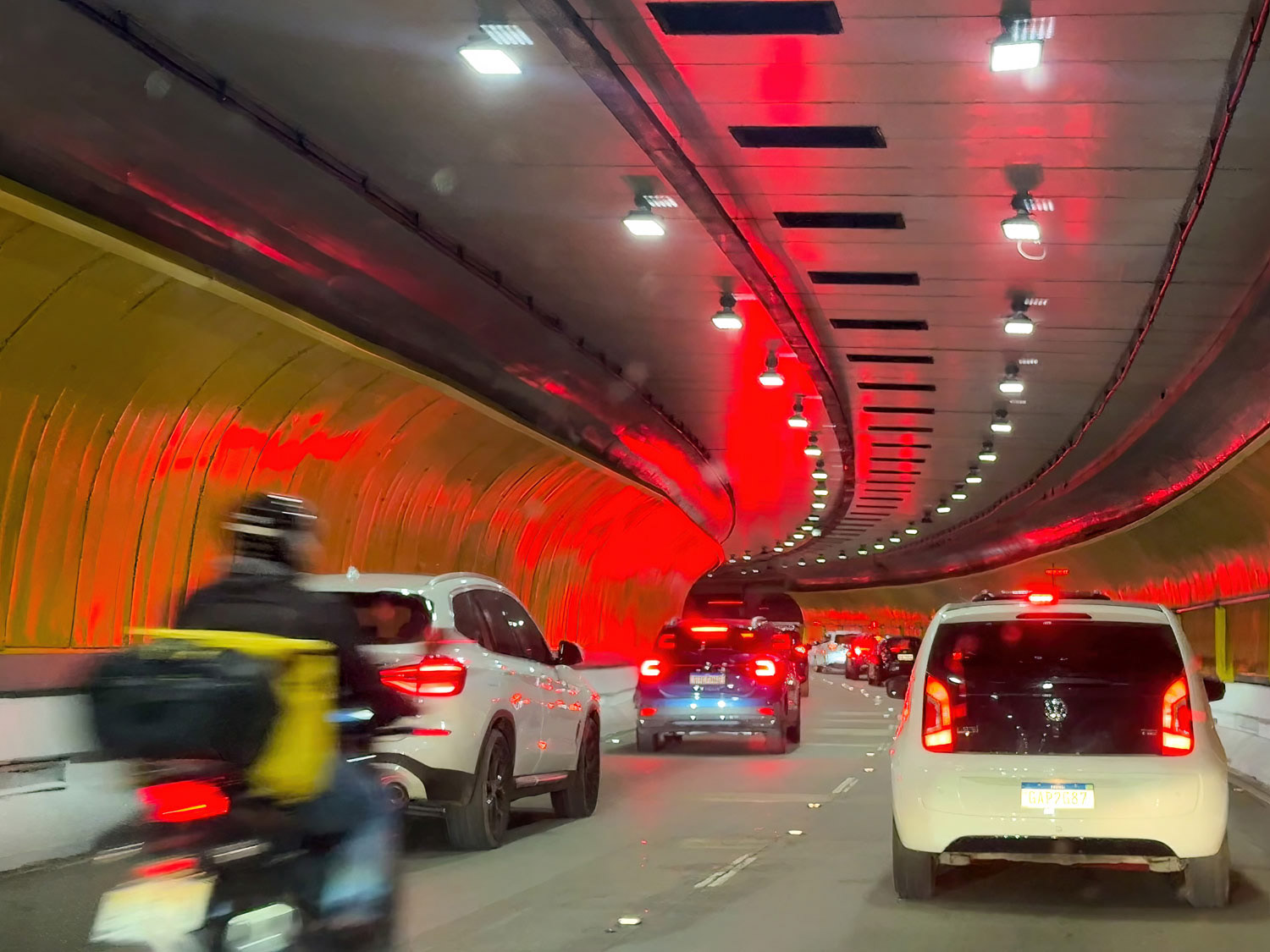
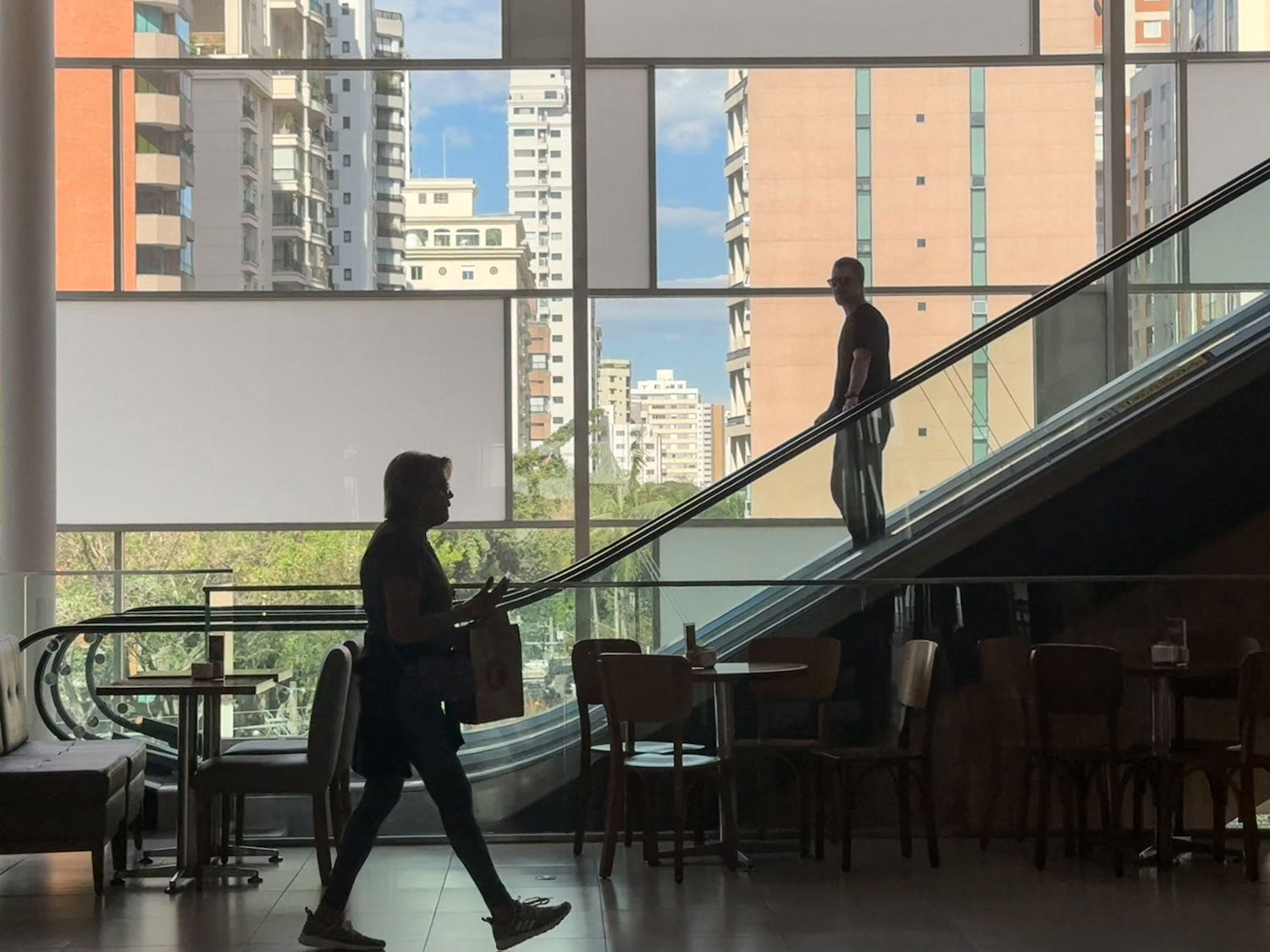
Sozinhos Juntos reúne dezesseis fotografias sobre uma condição específica: a de estar entre outras pessoas sem estar com elas. Uma plataforma de embarque, uma sala de espera, uma praia, um ônibus, uma praça, um túnel, um saguão de metrô, uma escada rolante. Em todas, mais de uma pessoa ocupa o mesmo espaço; em quase todas, nenhuma alcança a outra.
O conjunto não foi planejado. Quinze das dezesseis obras existiam antes de a série existir — algumas por mais de cinquenta anos — e foram reconhecidas como pertencentes a ela numa releitura do arquivo. Apenas uma foi produzida a partir do conceito. Isso significa que a série não é um projeto executado: é um padrão que estava no arquivo antes de alguém o nomear.
A separação não foi procurada. Ela já estava fotografada.
A LEI
O isolamento não é uma questão de distância
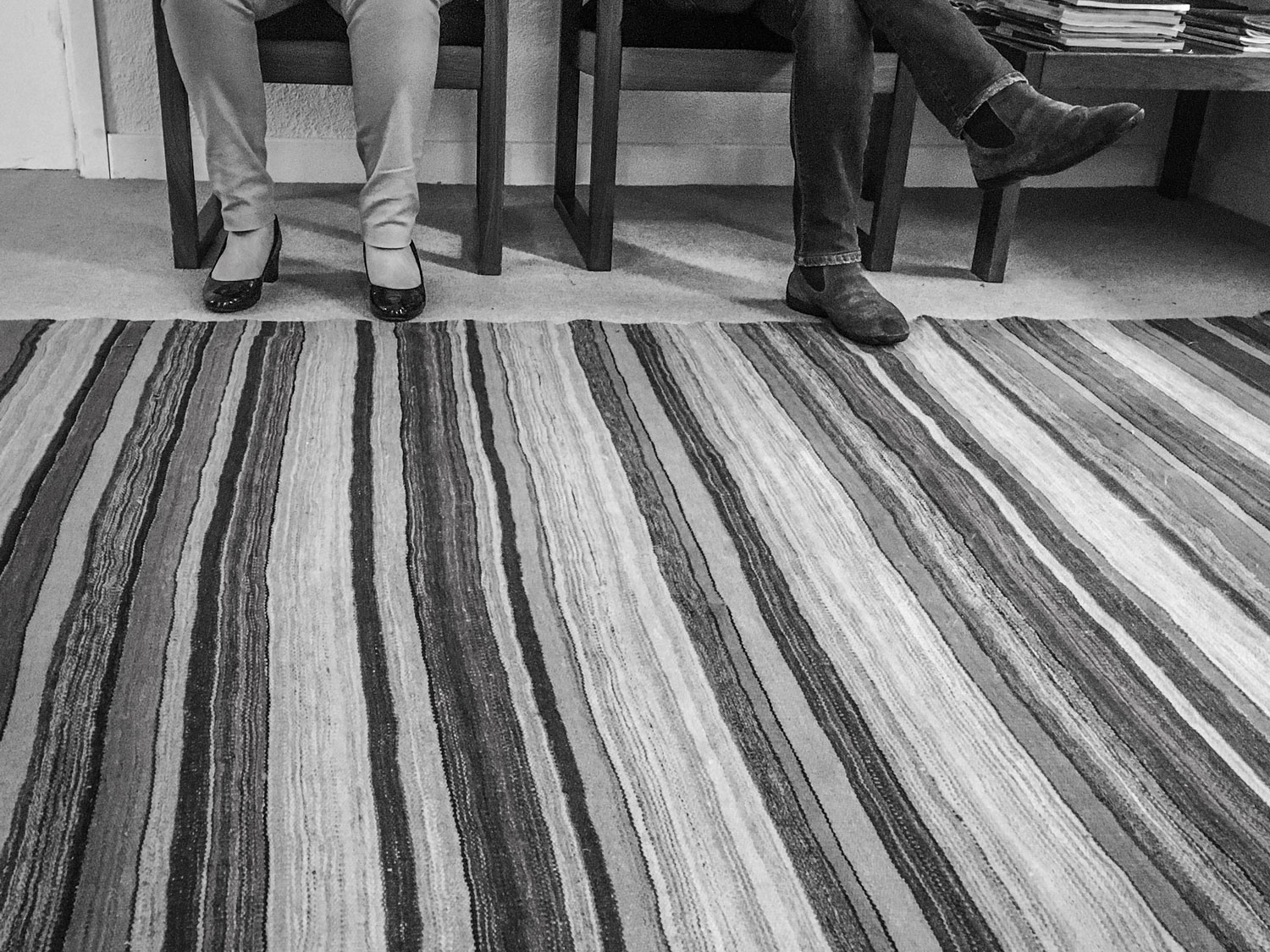
A regra que dá unidade a este conjunto não é a solidão em meio à multidão, e o próprio conjunto demonstra por quê. Numa das obras, duas pessoas ocupam cadeiras vizinhas — a proximidade máxima socialmente possível entre estranhos — e a separação sobrevive intacta, marcada por uma perna cruzada que funciona como barreira. Noutra, dezenas de banhistas se espalham por uma praia e uma criança agachada na beira da água não pertence a nenhum grupo. Nas duas, o resultado é o mesmo.
A lei é esta: o isolamento não depende do número de pessoas em volta nem da distância que as separa. Ele se instala por postura, por anteparo, por velocidade, por máscara, por indiferença — e em nenhum caso por falta de gente.
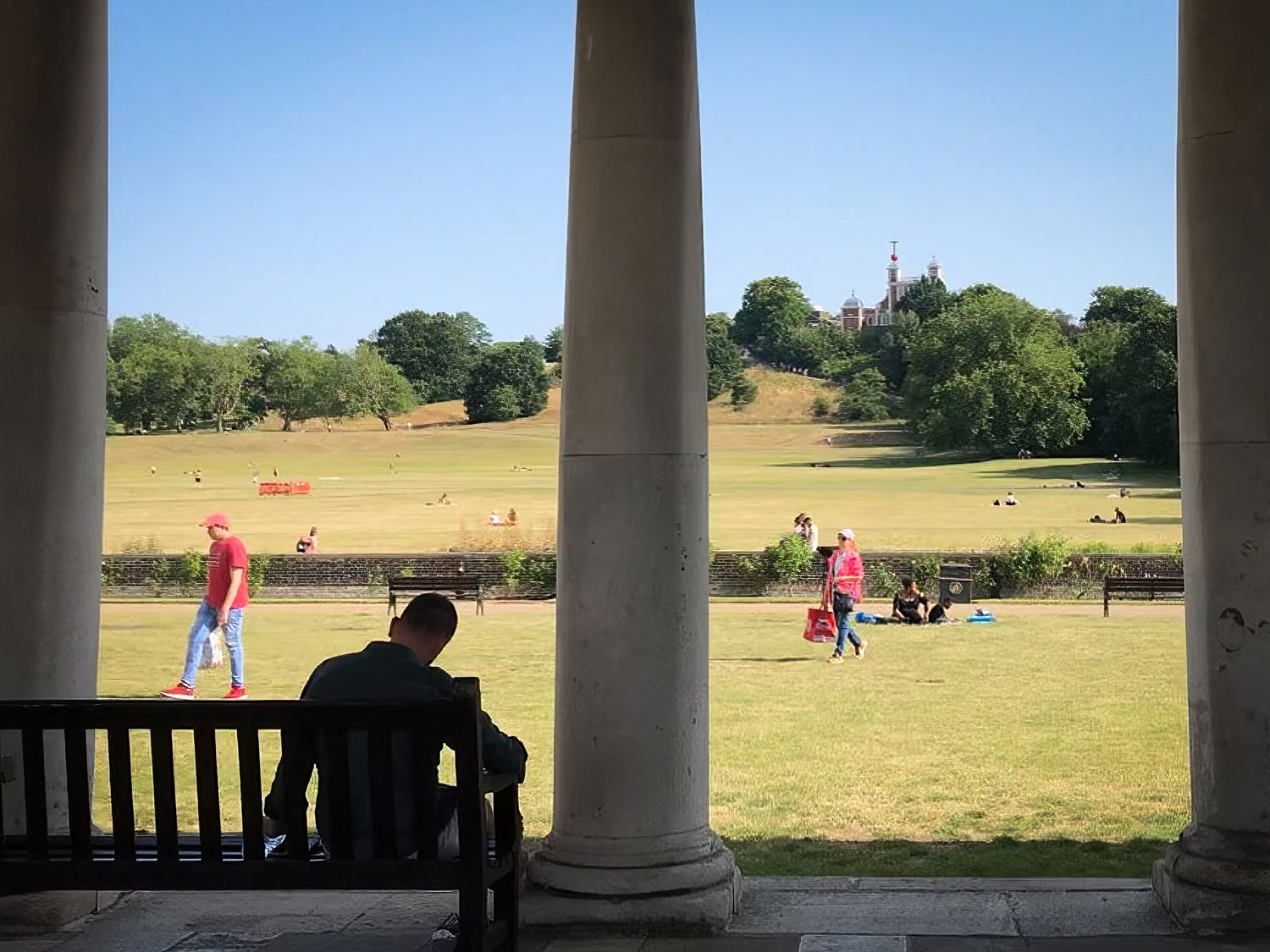
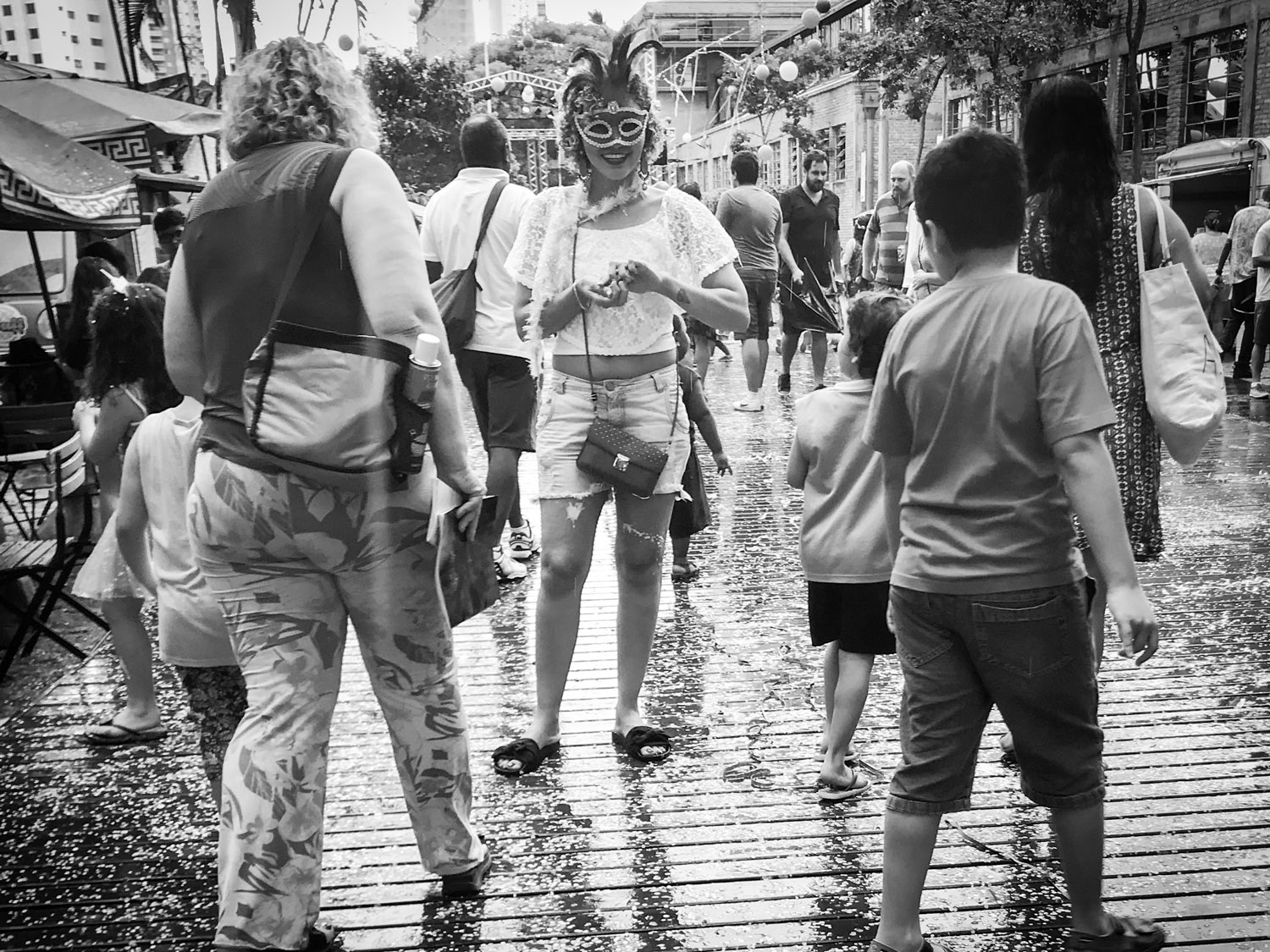
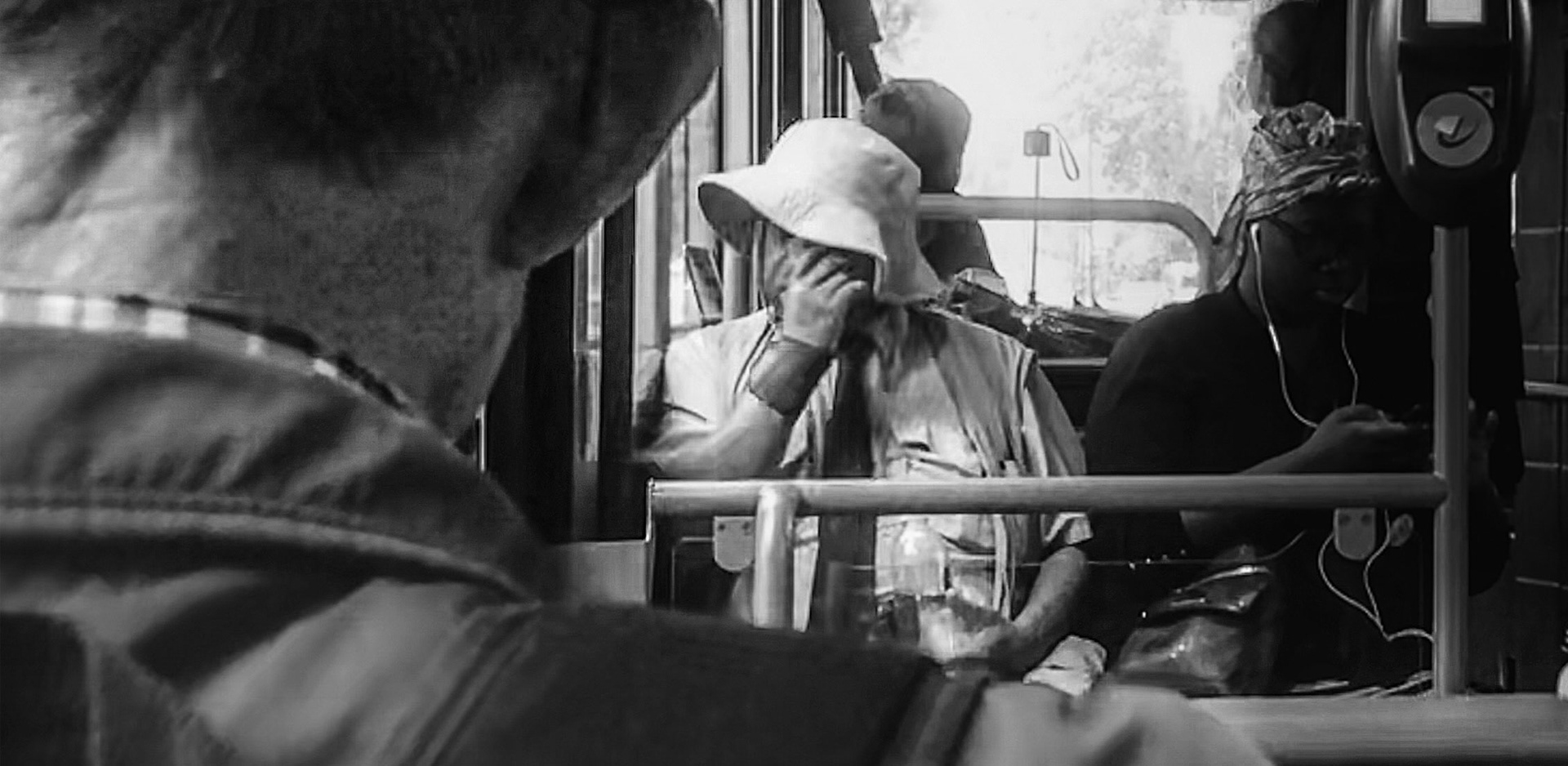
A série demonstra isso variando sistematicamente a causa. Em duas obras a separação é de velocidade: alguém está parado enquanto os outros se movem, ou o contrário. Em três, é de anteparo: colunas, barras de ônibus, montantes de madeira que compartimentam pessoas que não escolheram o compartimento. Em outras, é depostura, de olhar dirigido a ninguém, ou de uma máscara que impede até verificar se houve contato. Dezesseis obras, uma condição, oito mecanismos diferentes.
Alguém é finalmente olhado — e permanece igualmente inacessível.
O MÉTODO
O que se descobre depois
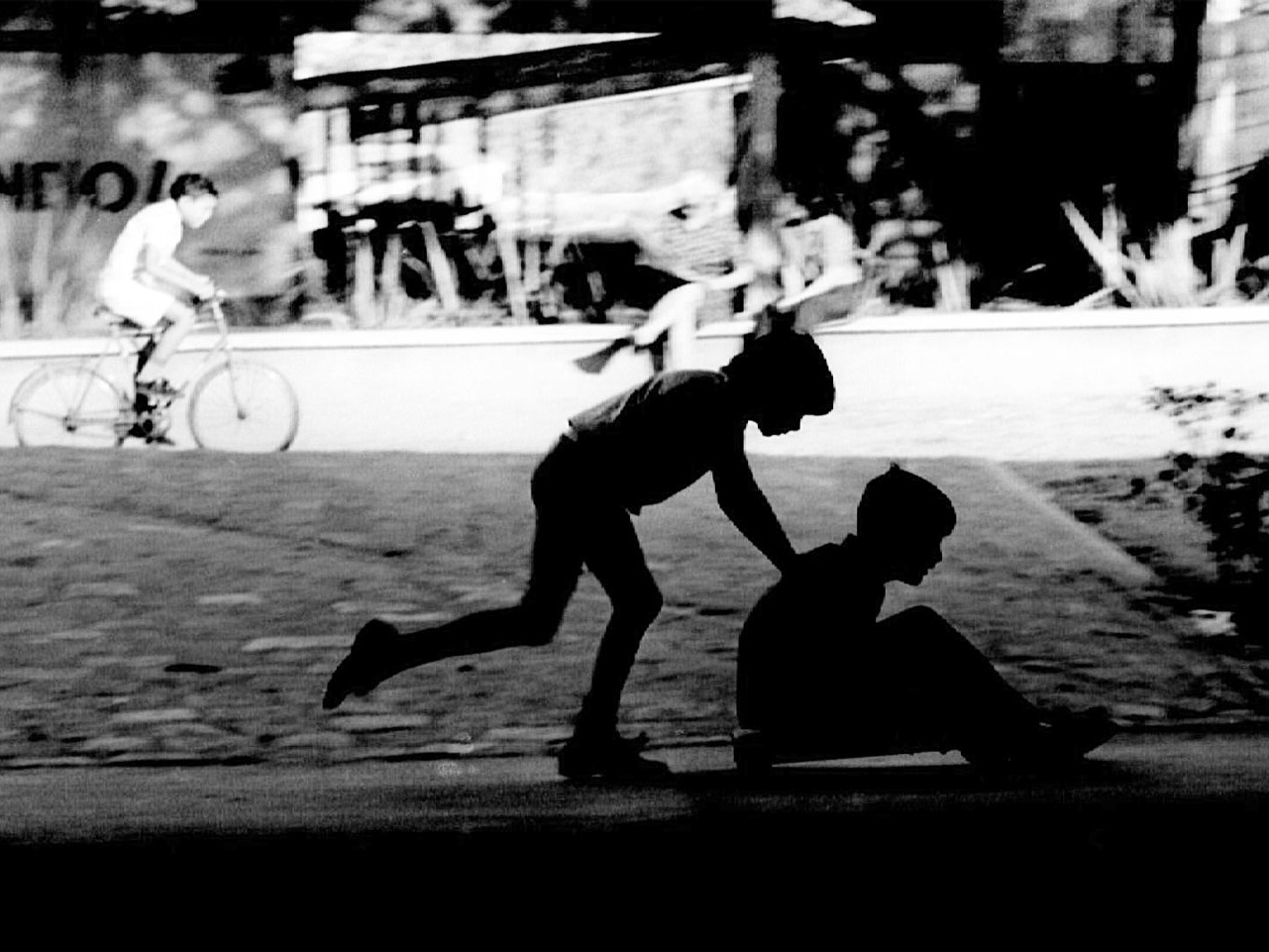
Em metade das obras deste conjunto, o elemento que qualifica a imagem para a série foi percebido apenas na revisão. Um menino de bicicleta ao fundo de uma rua de 1972. Um segundo menino olhando para uma figura mascarada. Um par de solas imóveis entre solas em movimento. A silhueta de um homem no canto escuro de uma rua de Quioto. Um homem borrado atravessando um saguão. A exatidão com que uma sombra veste um corpo sentado.
Não é distração. A artista explica o mecanismo ao documentar uma das obras: em muitas ocasiões ela vê a fotografia antes de fazê-la e sabe como vai ficar. Quando isso não acontece — e ela registra os casos em que não aconteceu —, a imagem guarda mais do que a intenção continha, e a descoberta se dá depois. Num trabalho feito majoritariamente com filme, ao longo de décadas, esse intervalo entre disparar e ver é a condição normal.
A consequência para esta série é estrutural. Duas das obras tiveram versões anteriores publicadas em recorte, e nas duas o que havia sido descartado é exatamente o que trouxe a imagem para o conjunto — a artista desfez os próprios cortes. A série, portanto, não apenas reuniu fotografias: devolveu a algumas delas partes que a autora tinha eliminado.
A consequência para esta série é estrutural. Duas das obras tiveram versões anteriores publicadas em recorte, e nas duas o que havia sido descartado é exatamente o que trouxe a imagem para o conjunto — a artista desfez os próprios cortes. A série, portanto, não apenas reuniu fotografias: devolveu a algumas delas partes que a autora tinha eliminado.
Registre-se também o limite oposto. Numa das obras, a artista voltou ao mesmo lugar dois dias depois, na mesma posição, para refazer a imagem com intenção — e não conseguiu. Noutra, declarou o resultado irrepetível. Numa autora cujo método é o retorno, que em outras séries voltou ao mesmo ponto durante anos, esses dois registros marcam onde a disciplina termina e o acaso começa.
A DISCRIÇÃO
Quase ninguém é identificável
Silhuetas contra fundo claro, figuras de costas, rostos cobertos por chapéu ou por máscara, corpos cortados na altura da cintura, solas de sapato vistas por baixo de um vidro, um rosto dissolvido pelo próprio movimento. Em quinze das dezesseis obras, as pessoas fotografadas não podem ser reconhecidas.
Isso não é efeito colateral do estilo. A artista enuncia o princípio ao documentar uma das obras, explicando por que atenuou a identificação de um veículo: não gosta de expor pessoas, a não ser quando absolutamente necessário. O que atravessava o conjunto como recorrência passou, com essa frase, a ser regra declarada.
Uma obra escapa à regra e o conjunto a trata como exceção consciente. Nela, três rostos aparecem nítidos e a cena atribui uma conduta a pessoas identificáveis; o documento respectivo registra a condição e devolve à autora a decisão sobre exibição, publicação e comercialização. A exceção só é defensável porque a regra está escrita.
AS DEZESSEIS OBRAS
Quatro movimentos
A numeração é de catálogo e segue a ordem em que as obras foram documentadas. A leitura do conjunto se organiza em quatro movimentos: a distância entre estranhos que dividem um espaço; a recusa ativa de quem se fecha; a passagem de quem atravessa sem ver; e a condição, distinta de todas as anteriores, de estar só sem que isso seja perda. As entradas abaixo avaliam o que cada imagem resolve e por que pertence ao conjunto.
MOVIMENTO I · A DISTÂNCIA ENTRE ESTRANHOS
MOVEMENTO II · A RECUSA
MOVIMENTO III · QUEM PASSA E NÃO VÊ
MOVIMENTO IV · ESTAR SÓ SEM PERDA
A LINHAGEM
Onde este conjunto se apoia
Cinco famílias atravessam as dezesseis obras. A autora não copia nenhuma delas: ocupa o lugar de cada uma por conta própria, e em dois casos inverte deliberadamente o dispositivo que herdou.
A figura alheia ao acontecimento
A composição em que uma grande figura em primeiro plano permanece indiferente ao tema central entrou na pintura ocidental com a Paisagem com a Queda de Ícaro, cuja concepção se atribui a Pieter Bruegel, o Velho, por volta de 1558 — a tela de Bruxelas é hoje tida como cópia antiga de um original perdido. Lá um lavrador ara sem notar que alguém caiu do céu; aqui o que passa despercebido é uma festa, e isso torna a proposição mais difícil.
O interior e a distância
Edward Hopper e Room in New York, de 1932, hoje no Sheldon Museum of Art: duas pessoas num mesmo cômodo, absortas em atividades separadas, com a distância articulada pela arquitetura e pela postura dos corpos. E Vilhelm Hammershøi, que entre 1898 e 1909 pintou dezenas de telas do próprio apartamento na Strandgade 30, em Copenhague, tratando a janela como recusa de diálogo com a rua.
A figura reduzida a recorte
Gustave Le Gray expondo pelo céu a partir de um só negativo em 1856, e o princípio que a própria autora formulou em outra série: a limitação da luz serve para produzir forma. Nesta série, o contraluz é o que elimina rostos, roupas e idades, e devolve pessoas reduzidas ao desenho do corpo — em plataformas, ruas, praias e fachadas de vidro.
O anônimo no transporte
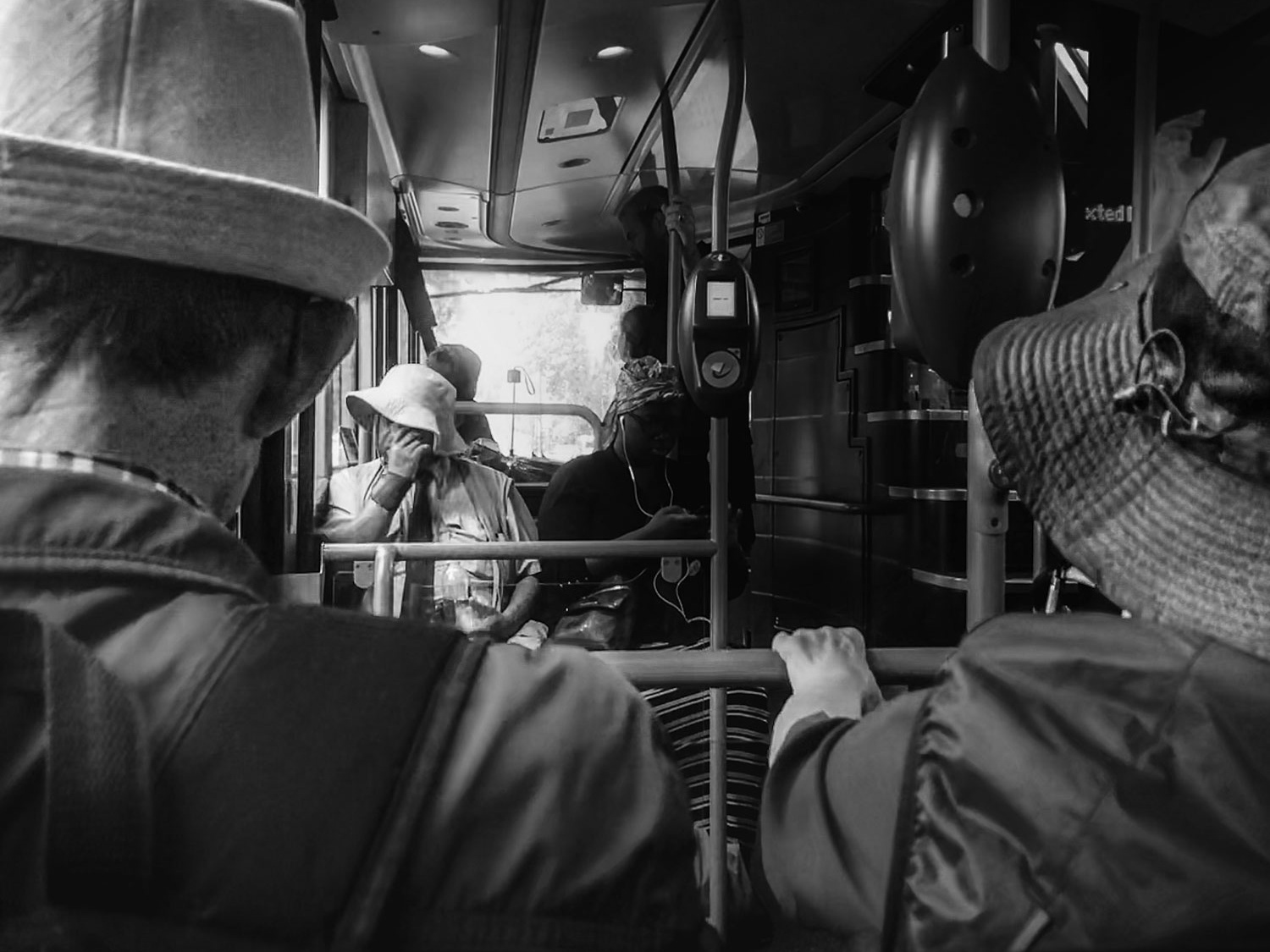
Entre 1938 e 1941, Walker Evans fotografou passageiros do metrô de Nova York com uma câmera escondida sob o sobretudo e disparador cabeado pela manga, acompanhado por Helen Levitt para passar despercebido; o conjunto virou Many Are Called. O que ele procurava, por suas palavras, era o instante em que a guarda baixa e a máscara cai. Numa obra desta série a situação é idêntica e o resultado é o oposto: a máscara sobe.
O trabalhador e a tipologia
August Sander, cujo projeto Menschen des 20. Jahrhunderts teve como única versão publicada em vida o livro Antlitz der Zeit, editado em Munique em 1929 com sessenta retratos e prefácio de Alfred Döblin, confiscado pelo regime nazista em 1936. A crítica da época identificou nele a rara capacidade de eliminar toda pose e toda máscara. Sander é o ancestral comum de Evans e dos Becher, já documentados na linhagem desta autora.
Cinco famílias, uma condição: estar entre pessoas sem estar com elas.
POSICIONAMENTO
Por que esta série importa
AS DEZESSEIS JUNTAS
O que sobra quando ninguém se alcança
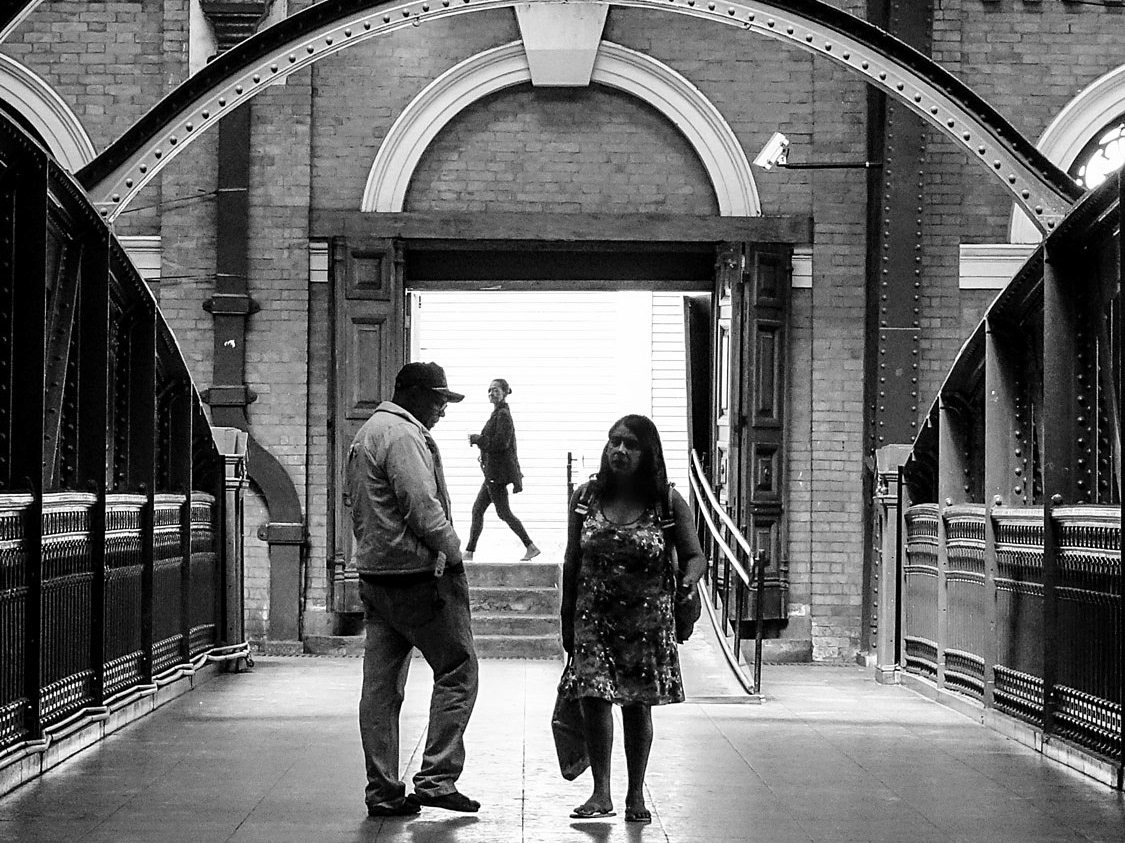
Vistas em sequência, as dezesseis fotografias não formam um inventário de solidões. Formam a descrição de uma distância que não se mede em metros. Ela aparece entre duas pessoas em cadeiras vizinhas e entre dezenas espalhadas por uma praia; entre quem se move e quem espera; entre quem olha e quem usa máscara; entre alguém que atravessa um saguão e uma festa acontecendo às suas costas.
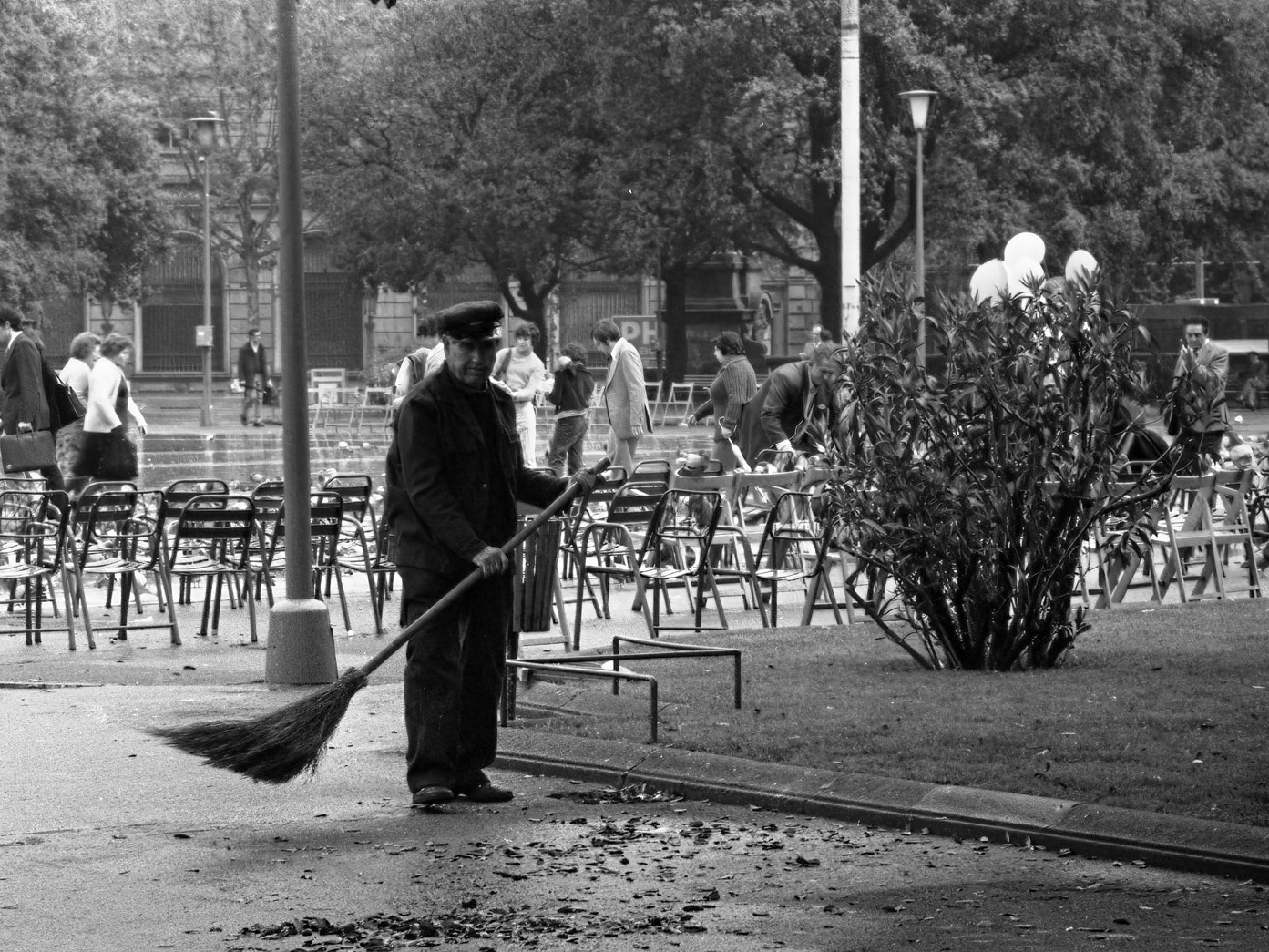
E o conjunto termina sem condenar essa distância. A última obra mostra um homem varrendo uma praça preparada para receber multidão, sozinho no meio dos preparativos, e a autora vê nele dignidade e não privação. Numa série construída sobre o desencontro, a imagem final é a de alguém que está bem onde está.
A artista declarou, ao documentar uma das obras, o que entende ser o propósito do seu trabalho: mostrar coisas que valem a pena ser vistas, embora as pessoas passem e não reparem. Ela nunca havia dito isso em cinquenta anos. Foi preciso fotografar dezesseis vezes gente que não olha para que a fotógrafa dissesse o que faz.
Dezesseis vezes a mesma distância — e nenhuma pressa em resolvê-la.
Consultoria Curatorial e Estratégica · Chirlei Bastos · Direção Curatorial
m
Sixteen works · photography · four countries · more than fifty years
Being close is not being together.
THE ARTIST
Fifty Years Watching People Pass By
Half a century of photography, preceded by a background in design and followed by two decades in art direction. From that background comes the most visible trait of this body of work: an eye trained in proportion, deciding where each figure falls within the frame and how the masses balance — and one that, in several of these works, resolved the composition before the artist herself knew what the subject was.
The archive spans more than fifty years and four countries. The tools vary while the eye remains unchanged: there are black-and-white negatives developed decades ago, images made with a mobile phone, a compact camera, and a photograph taken from inside a moving car. What recurs is neither the equipment nor the place — it is the position of someone who observes without taking part.
This artist has a stated method and a stated limit. The method is to see the photograph before making it: she says that on many occasions she knows beforehand what the image will look like. The limit appears when that does not happen — and it is precisely among those works that the series took shape.
THE SERIES
Sixteen Times the Same Distance
Alone Together brings together sixteen photographs about a specific condition: being among other people without being with them. A departure platform, a waiting room, a beach, a bus, a square, a tunnel, a subway concourse, an escalator. In every one, more than one person occupies the same space; in almost every one, no one reaches another.
The body of work was not planned. Fifteen of the sixteen works existed before the series did — some for more than fifty years — and were recognized as belonging to it through a rereading of the archive. Only one was produced from the concept. This means that the series is not a project that was carried out: it is a pattern that was already present in the archive before anyone gave it a name.
The separation was not sought. It was already there, photographed.
THE LAW
Isolation Is Not a Matter of Distance
The rule that gives this body of work its unity is not solitude amid a crowd, and the works themselves demonstrate why. In one, two people occupy adjacent chairs — the closest socially possible proximity between strangers — and the separation remains intact, marked by a crossed leg that acts as a barrier. In another, dozens of bathers are scattered across a beach while a child crouching at the water’s edge belongs to no group. In both, the result is the same.
The law is this: isolation does not depend on the number of people around us, nor on the distance separating them. It takes hold through posture, through barriers, through speed, through masks, through indifference — and never, in these works, through an absence of people.
The series demonstrates this by systematically varying the cause. In two works, separation is a matter of speed: someone is still while the others move, or the reverse. In three, it is a matter of barriers: columns, bus rails, wooden mullions that partition people who did not choose the compartment. Elsewhere, it arises from posture, from a gaze directed at no one, or from a mask that makes it impossible even to determine whether contact occurred. Sixteen works, one condition, eight different mechanisms.
Someone is finally looked at — and remains just as inaccessible.THE METHOD
What Is Discovered Later
In half the works in this series, the element that qualifies the image for inclusion was noticed only upon review. A boy on a bicycle in the background of a street in 1972. A second boy looking at a masked figure. A pair of motionless soles among soles in motion. The silhouette of a man in the dark corner of a Kyoto street. A blurred man crossing a concourse. The precision with which a shadow fits a seated body.
This is not inattention. The artist explains the mechanism while documenting one of the works: on many occasions, she sees the photograph before making it and knows how it will turn out. When that does not happen — and she records the instances when it did not — the image retains more than the intention contained, and the discovery comes later. In a body of work made predominantly on film over the course of decades, this interval between taking the picture and seeing it is the normal condition.
The consequence for this series is structural. Two of the works had previously published cropped versions, and in both, what had been discarded is precisely what brought the image into the series — the artist undid her own crops. The series, then, did more than bring photographs together: it restored to some of them parts the artist herself had eliminated.
The opposite limit should also be noted. In one work, the artist returned to the same place two days later, to the same position, to remake the image intentionally — and could not. In another, she declared the result unrepeatable. For an artist whose method includes returning — who, in other series, has gone back to the same spot for years — these two instances mark where discipline ends and chance begins.
DISCRETION
Almost No One Is Identifiable
Silhouettes against bright backgrounds, figures seen from behind, faces covered by hats or masks, bodies cut off at the waist, the soles of shoes seen from beneath a glass floor, a face dissolved by its own movement. In fifteen of the sixteen works, the people photographed cannot be recognized.
This is not a side effect of the style. The artist states the principle while documenting one of the works, explaining why she made a vehicle less identifiable: she does not like to expose people unless absolutely necessary. What had run through the series as a recurring feature became, with that statement, an explicit rule.
One work falls outside the rule, and the series treats it as a deliberate exception. In it, three faces are clearly visible and the scene attributes conduct to identifiable people; its documentation records that condition and returns to the artist the decision of whether to exhibit, publish, or sell the work. The exception is defensible only because the rule is written down.
THE SIXTEEN WORKS
Four Movements
The catalogue numbers follow the order in which the works were documented. The series can be read in four movements: the distance between strangers sharing a space; the active refusal of those who close themselves off; the passage of those who move through without seeing; and the condition, distinct from all the others, of being alone without that being a loss. The entries below consider what each image resolves and why it belongs in the series.
MOVEMENT I · THE DISTANCE BETWEEN STRANGERS
MOVEMENT II · REFUSAL
MOVEMENT III · THOSE WHO PASS BY WITHOUT SEEING
MOVEMENT IV · BEING ALONE WITHOUT LOSS
THE LINEAGE
Where This Body of Work Stands
Five families run through the sixteen works. The artist copies none of them: she arrives at each on her own terms, and in two cases deliberately reverses the device she inherited.
The Figure Unaware of the Event
The composition in which a large foreground figure remains indifferent to the central event entered Western painting with Landscape with the Fall of Icarus, whose conception is attributed to Pieter Bruegel the Elder, around 1558 — the Brussels painting is now considered an early copy of a lost original. There, a ploughman goes on ploughing, unaware that someone has fallen from the sky; here, what goes unnoticed is a celebration, which makes the proposition more difficult.
The Interior and Distance
Edward Hopper and Room in New York, from 1932, now at the Sheldon Museum of Art: two people in the same room, absorbed in separate activities, with distance articulated through architecture and bodily posture. And Vilhelm Hammershøi, who between 1898 and 1908 painted dozens of interiors of his own apartment at Strandgade 30 in Copenhagen, treating the window as a refusal of dialogue with the street.
The Figure Reduced to Silhouette
Gustave Le Gray exposing for the sky from a single negative in 1856, and the principle the artist herself formulated in another series: the limitation of light serves to produce form. In this series, backlighting eliminates faces, clothing, and ages, returning people to the mere outline of the body — on platforms, streets, beaches, and glass façades.
The Anonymous Passenger
Between 1938 and 1941, Walker Evans photographed passengers on the New York City subway with a camera concealed beneath his overcoat and a cable release running down his sleeve, with Helen Levitt accompanying him so that he would go unnoticed; the series became Many Are Called. What he sought, in his own words, was the moment when the guard comes down and the mask comes off. In one work in this series, the situation is identical and the result the opposite: the mask goes up.
The Worker and Typology
August Sander, whose project Menschen des 20. Jahrhunderts had as its only version published during his lifetime the book Antlitz der Zeit, issued in Munich in 1929 with sixty portraits and a preface by Alfred Döblin, and confiscated by the Nazi regime in 1936. Contemporary critics identified in it the rare ability to eliminate all pose and every mask. Sander is the common ancestor of Evans and the Bechers, already documented in this artist’s lineage.
Five families, one condition: being among people without being with them.
POSITIONING
Why This Series Matters
THE SIXTEEN TOGETHER
What Remains When No One Reaches Another
Seen in sequence, the sixteen photographs do not form an inventory of solitudes. They describe a distance that cannot be measured in meters. It appears between two people in adjacent chairs and among dozens scattered across a beach; between those who move and those who wait; between those who look and those who wear a mask; between someone crossing a concourse and a celebration taking place behind their back.
And the series ends without condemning that distance. The final work shows a man sweeping a square being prepared for a crowd, alone amid the preparations, and the artist sees dignity in him rather than deprivation. In a series built around missed connections, the final image is of someone who is perfectly well where he is.
While documenting one of the works, the artist stated what she understands the purpose of her work to be: to show things worth seeing, even though people pass by without noticing them. She had never said this in fifty years. It took photographing people who do not look, sixteen times, for the photographer to say what it is she does.
Sixteen times the same distance — and no hurry to resolve it.
Curatorial and Strategic Consulting · Chirlei Bastos · Curatorial Direction